An Oscar-Winning Director Called the AI Economy a Ponzi Scheme. Is He Right?
A Documentary That Punched Silicon Valley in the Gut
On March 27, a documentary called The AI Doc opened in the United States.
The director is Daniel Roher—the guy who won the 2022 Oscar for Best Documentary Feature for Navalny. That film exposed the lies of the Russian state. This time, he turned his camera on Silicon Valley.
The core argument, in one sentence:
The current AI economy is, at its core, an elaborately packaged Ponzi scheme.
Silicon Valley exploded. Wall Street got uncomfortable. Reddit devolved into chaos.
But here’s the thing: whether or not you agree with the conclusion, the questions he’s raising are worth taking seriously.
“Where Does the Money Come From?” — The Question Nobody Wants to Answer
Start with this number: over 80% of AI startups fail to turn a profit within five years.
This isn’t speculation. Check the financials of any major AI company—OpenAI, Anthropic, Stability AI—most of them are burning cash. Not trickle-burning. Burning in billions.
So where does the money come from? The next funding round.
And what does the next funding round depend on? A bigger story.
And what does the bigger story require? More funding to validate it.
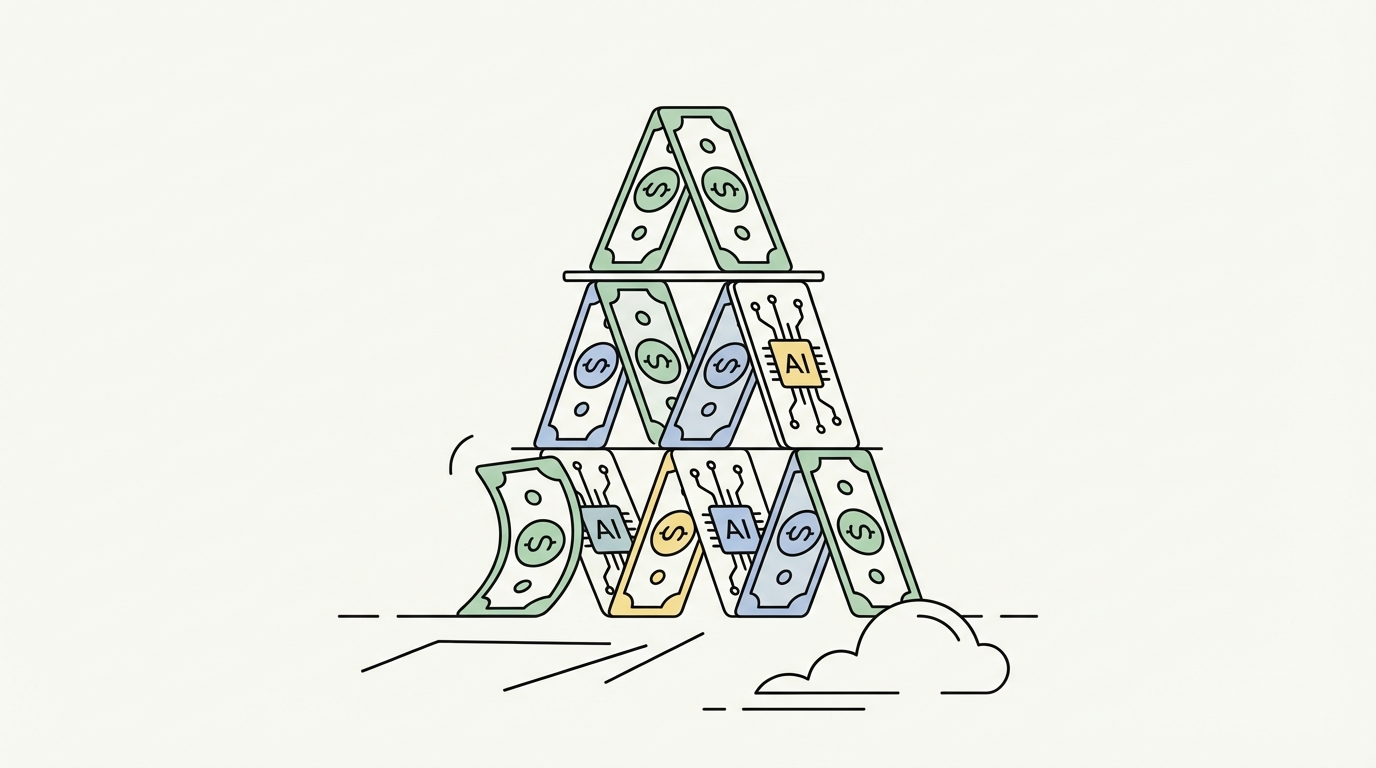
Isn’t that the classic Ponzi structure? — using new investors’ money to show “growth” to old investors.
In an interview with Vanity Fair, Roher said something I think is exactly right:
“When everyone in an industry is talking about the future but nobody can explain where today’s profits come from, that should alarm you. This isn’t a revolution. It’s a financial game dressed up in revolutionary language.”
Media analyst Evan Shapiro had already predicted an AI sector “crash” in 2026, writing for C21 Media: if 90% of companies in an industry aren’t making money, no matter how good the story told by the other 10%, the valuations can’t hold.
That sounds harsh. But think about China’s “hundred models war.” From 2023 to 2025, over a hundred large language model companies launched overnight. How many are still functioning in 2026? Most of their names are already forgotten.
But Jensen Huang Disagrees
To be fair, you have to hear the other side.
NVIDIA CEO Jensen Huang is unequivocal: AI is the next industrial revolution after the internet. All current investment is infrastructure-building.
His argument: when the internet was just starting, there were also waves of companies burning cash, losing money, going under. But the ones that survived—Google, Amazon, Facebook—changed the world.
That’s a reasonable analogy.
But there’s a key difference: the “infrastructure investment” of the internet era was fiber optic cable, servers, bandwidth—build it once and it’s there for everyone to use. AI’s “infrastructure investment” has massive ongoing costs, and the technology iterates so fast that last generation’s products can be obsolete in months.
The internet built a road everyone can drive on. AI keeps building cars whose fuel costs more than the car.

There’s also something Jensen doesn’t love to bring up: NVIDIA is the biggest “pickaxe seller” of the AI gold rush. Doesn’t matter if anyone finds gold—the pickaxe guy always profits.
So when “the pickaxe seller” tells you the gold mine is real, you should at least ask: is he reporting a fact, or selling pickaxes?
The Title Hides an Attitude
The film’s full title is The AI Doc: Or How I Became an Apocaloptimist.
“Apocaloptimist” — an apocalyptic optimist. Roher invented the word himself. The meaning: I acknowledge this thing might bring catastrophe, but I choose to believe humans can handle it.
This is what makes the film interesting—it’s not just doom-and-gloom about AI.
Roher interviews Sam Altman (OpenAI CEO), Tristan Harris (the Social Dilemma guy), and a parade of other big names. Some say AI is the greatest invention in human history. Others say it might wipe us out.
Roher doesn’t take sides. He does something harder: he puts everyone’s words side by side and lets you decide who’s telling the truth and who’s selling a story.
After the Sundance premiere, reviews split sharply. Some called it “the most important documentary of 2026.” Others said “too much information, not enough depth.” Whatever your take, one thing is certain: this film asked the question the whole industry least wants to answer.
What This Actually Means for the Rest of Us
Honest take: I’ve always been clear on the bubble question.
Bubbles and value have never been mutually exclusive.
The dot-com bubble burst in 2000. NASDAQ dropped 78%. But was the internet itself fake? No. Pets.com died. Google survived.
AI is probably the same script: the technology is real, the bubble is real. Most companies will die, and a few will change the world.
The real questions aren’t “is AI a Ponzi scheme?” They’re:
- Are you using AI to solve real problems, or chasing concepts?
- Can the company behind your AI tools survive the next winter?
- If every AI company’s valuation got cut in half tomorrow, would your life and work be affected?
My own approach is simple: only pay for AI tools that are already making or saving me money. Never pay for the concept of “might be powerful someday.”
That standard cut 90% of my AI subscriptions. What’s left is the 10% I’m actually using that’s actually creating value.
Another angle worth considering: is your skill set tied to a single AI company?
If your entire workflow depends on one AI tool and it shuts down tomorrow, are your skills still there? Or do you start from scratch?
Real AI skills aren’t “knowing how to use a product.” They’re “understanding what AI can do, what it can’t, and how to get it to do things well.” That meta-skill doesn’t disappear when a company goes under.
The bubble will pop. But what you actually learned from inside the bubble won’t.

Should You Watch It?
The AI Doc opened in the US on March 27 via Focus Features. Chinese audiences probably won’t see a theatrical release anytime soon, but based on past experience, a streaming version shouldn’t be far behind.
Don’t just watch for the conclusion. Watch how he asks the questions.
Good documentaries don’t give you answers—they give you better angles to think from. On this front, a director who already exposed Putin’s assassination plots is a better questioner than most tech journalists.
For what it’s worth, Roher himself says he’s not against AI technology. What he’s against is the financial narrative built around AI. Technology can change the world—but the sentence “this technology will change the world” can also be packaged and sold.
Knowing the difference between those two things is the most important skill anyone can have in the age of AI.
My own prediction: 2026 will see a wave of AI company failures. But that doesn’t mean AI is over—quite the opposite. After the bubble squeezes out, the companies with real value will accelerate. Just like Google accelerated after the dot-com crash.
No need to panic. But stay clear-eyed. Use AI, learn from AI, extract real value from AI—but don’t bet your future on any single AI company’s valuation.
The technology is real. The money is real. The question is: are you making money from the technology, or from the story? Figure that out—it’s worth more than watching ten documentaries.
Thanks for reading.