You Use AI Every Day. Your Brain Is Quietly Shrinking.
Let me tell you something that happened to me.
One night last week, I sat down at my desk to update my blog. I opened the document, put my hands on the keyboard — and froze.
It wasn’t that I didn’t know what to write. The topic was picked, the research was done, the outline was ready. But my brain just wouldn’t start.
The first sentence… what was I going to say again?
I stared at the screen for about ten minutes, then instinctively opened a chat window and typed: “Write me an opening paragraph.”
AI gave me a polished paragraph in three seconds flat. I read it, thought it was fine — and simultaneously felt… nothing. Like when someone says “it’s fine” and you know they mean it’s not.
On another occasion, on a perfectly sunny afternoon, my OpenClaw burned through my entire Claude MAX quota. I slapped my forehead — well, nothing I can do now, might as well take a break.

Then I just… sat there. With nothing to do. Every pendulum had stopped swinging. I felt like Zhuge Liang standing on his straw boats, feather fan in hand: Everything is ready — except the tokens.
Later I thought about it. It wasn’t that I’d forgotten how to work. It was that I’d gotten used to not working. The startup cost of thinking had become too high, while the cost of calling AI was essentially zero.
Then I came across this study.
Harvard and BCG Say: Your Brain Is Getting “Fried”
On March 5, 2026, Harvard Business Review published a study in partnership with Boston Consulting Group (BCG). Normally, I’d roll my eyes at any headline screaming “AI is destroying your brain” — it’s usually clickbait sensationalism, and I skip it on principle. But this was HBR plus BCG. That’s a bit too heavyweight to ignore. So I read it.
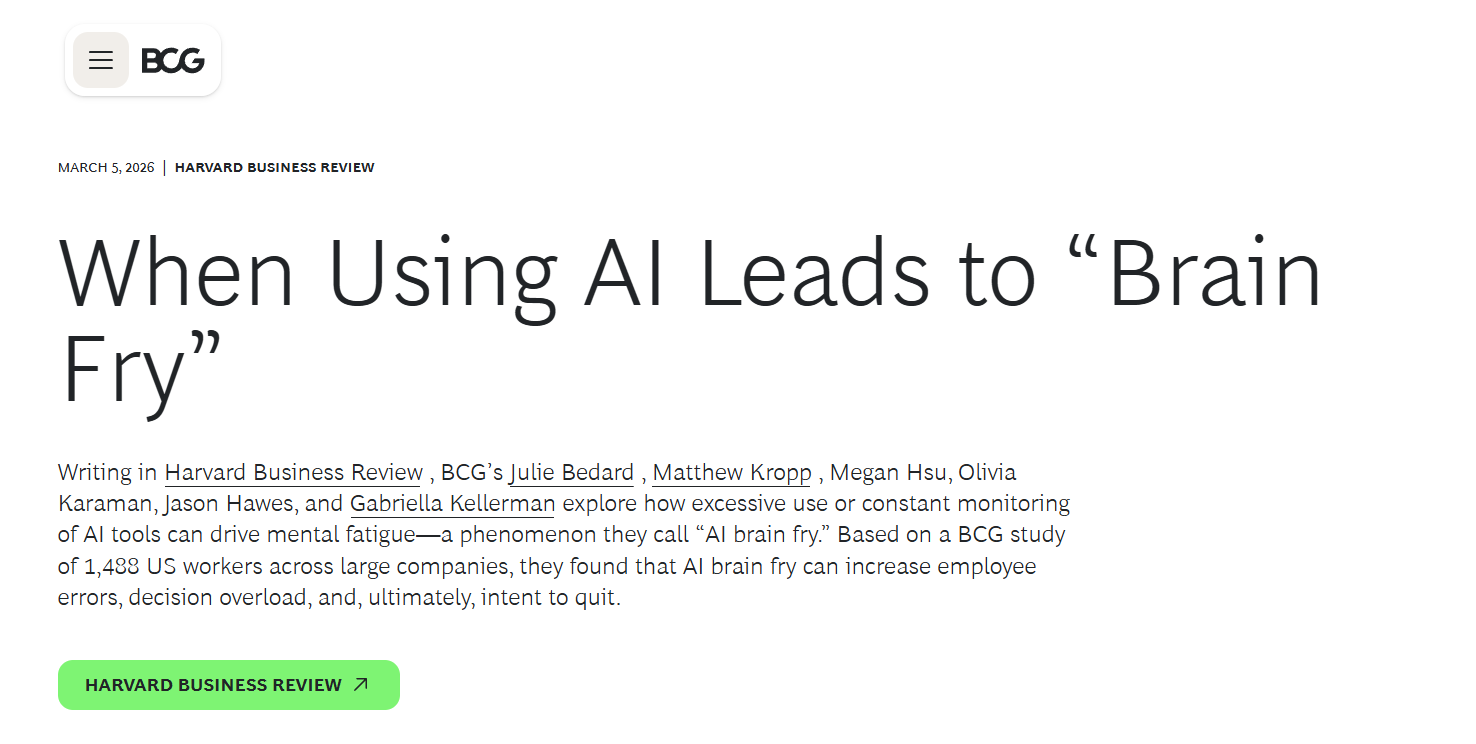
They coined a new term: Brain Fry.
Sounds like an internet meme, but it’s actually a serious research concept. The team surveyed nearly 1,500 full-time employees at large American companies and found that 14% of AI users were experiencing this condition.
So what does “Brain Fry” actually feel like? Here’s how the respondents described it:
- A constant “buzzing” in their head — like a fan running nonstop but unable to dissipate the heat
- Brain fog — thinking through things feels like looking through frosted glass, everything blurry and indistinct
- Difficulty concentrating — starting one task and immediately wanting to switch to another
- Slower decision-making — things that used to take three seconds to decide now involve minutes of hesitation
- Headaches, especially after extended AI tool usage
- A feeling that their brain is stuffed full of information, but they can’t articulate what’s actually in there
The Numbers Are Scarier Than the Feelings
If it were just “my brain is tired,” a good night’s sleep would fix it. But the numbers in this study go way beyond tired.
Employees experiencing Brain Fry showed:
- Minor errors up 11%
- Major errors up 39%
- Decision fatigue 33% higher than unaffected colleagues
- Intention to quit 39% higher
A 39% increase in major errors. Picture this — a financial analyst, fogged by AI-induced cognitive fatigue, makes a bad call on a major investment. A doctor, over-reliant on AI diagnostic tools, misses a critical abnormal indicator. A programmer, having reviewed AI-generated code until their brain stopped turning, lets a fatal bug slip through.
The study also revealed something deeply counterintuitive: the most exhausting part isn’t “using AI” — it’s “supervising AI.”
Employees who intensively supervised AI tools reported:
- 14% more mental engagement
- 12% more mental fatigue
- 19% more information overload
Ha — reading that, I actually laughed. Just yesterday I was complaining about how my OpenClaw (my AI assistant, a lobster named PiPiXia) keeps making mistakes I have to correct, and how exhausting the endless cycle of correction feels. On top of that, I’d just accomplished something big: connecting my cloud-based OpenClaw with Claude Code running on my local Windows machine, and having them formally introduce themselves to each other. They even negotiated their own division of labor:

I thought — great, with these two heavenly soldiers on the job, I can finally relax. Hand all the decisions to PiPiXia, let it delegate to Claude Code, and just sit back.
But I’m still the one watching over everything. Every single day.
Every review session is an act of intense cognitive labor. And this kind of labor is more exhausting than doing the work yourself — because you’re making judgments within someone else’s thought process, instead of advancing your own.
It’s like how grading someone else’s homework is more tiring than doing your own.
Your Brain Is Being “Outsourced”
This study reminded me of a psychology concept: Cognitive Offloading.
In plain English: humans are naturally inclined to outsource mental work to tools.
We used to take notes on paper — outsourcing memory to the page. Then we used phone memos — outsourcing to the device. Then search engines — no need to memorize facts, just know how to Google them.
Each round of outsourcing gave us efficiency but cost us a bit of capability.
How many phone numbers can you recite from memory right now? No more than five, right?
AI has pushed cognitive offloading to an unprecedented level.
Before, you were outsourcing memory — your phone remembered phone numbers for you. Now you’re outsourcing thinking — AI writes your emails, makes your decisions, even judges whether something is worth doing.
The consequence of outsourcing memory was forgetting phone numbers. The consequence of outsourcing thinking?
You stop knowing how to think.
Not literally — but the muscles of thought atrophy. Like taking the elevator instead of the stairs: your leg muscles slowly waste away. The brain works the same way — use it or lose it.
For me, the progression went like this: first I’d open a browser tab and go back and forth with GPT. Then Cursor, doing development step by step with AI assistance. Then Claude Code, knocking things out in one go with just occasional check-ins. Now OpenClaw, working through the night while I sleep, serving up results by morning.
Faster? Absolutely. But that ability to “think up a good opening from scratch, on my own” — I can feel it weakening. At the same time, I wonder: maybe that ability isn’t as important as I thought? Like being able to do mental math perfectly in elementary school, or reciting 300 Tang poems — it’s not useless as an adult, but… the impact is way smaller than you’d imagined?
How Many of These Apply to You? A Self-Test
Based on BCG’s research data, I put together an informal self-assessment. This isn’t a medical diagnosis, but if 3 or more apply to you — well, let’s just say you and AI have a pretty intimate relationship.
□ 1. Before writing anything, your first instinct is to ask AI Not because you can’t write — just out of habit. Even for a text message or a simple email.
□ 2. Without AI, your brain feels like it “boots up slower” You used to jump into work mode quickly. Now, without AI assistance, it feels like you’re missing a leg.
□ 3. After extended AI use, you get headaches or a “buzzing” in your head Not a physical sound — more like a mental static noise.
□ 4. Your decision-making speed has dropped Not because there are more options, but because your confidence in your own judgment is declining. “Let me check what AI thinks” has become your catchphrase.
□ 5. You have 3+ AI tools open simultaneously ChatGPT, Copilot, AI notes, AI search… the more windows open, the dizzier you feel.
□ 6. Reviewing AI output is more exhausting than doing it yourself The time spent checking whether AI made mistakes sometimes exceeds the time it would take to just do it from scratch.
□ 7. You think AI writes better than you do You’ve lost confidence in the quality of your own output.
BCG’s study uncovered a particularly interesting finding: there’s a cognitive ceiling for the number of AI tools used simultaneously. Going from 1 tool to 2 significantly boosts productivity. From 2 to 3, it’s still going up but noticeably slowing. Beyond 4 — productivity actually drops.
More tools, dumber humans. That’s not a joke. It’s data.
Who’s Most Vulnerable
The study also broke things down by industry. Highest Brain Fry rates:
- Marketing: 26%
- Human Resources: 19%
- Operations: 18%
- Software Engineering: 18%
- Legal/Compliance was lowest: 5%
A quarter of all marketing professionals are experiencing brain fry. Makes sense when you think about it — marketers use AI daily for copywriting, creative work, data analysis, reports. They want AI in every step of the process. The heaviest users get burned the worst.
Legal and compliance had the lowest rates because their industry has the lowest trust in AI output — they don’t dare let AI take over too much, which ironically protected them.
Isn’t it ironic? The people who don’t trust AI are the ones AI hasn’t hurt.
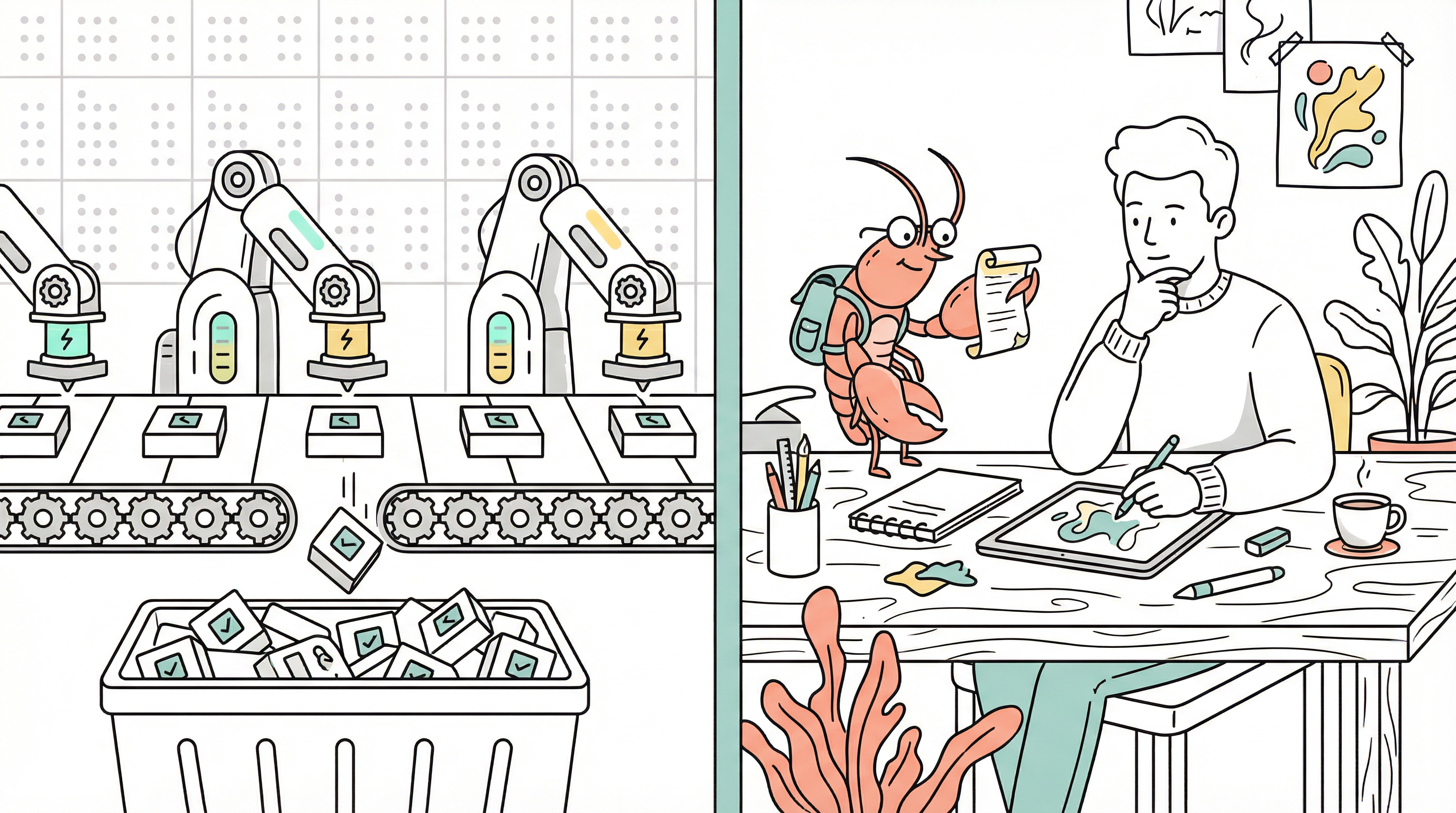
Five Things You Can Do
Enough about problems — time for solutions. Here are five recommendations combining BCG’s suggestions with my own experience:
1. Think before you ask.
This is the most important one. Before opening ChatGPT, spend 5 minutes thinking on your own. Even if what you come up with is rough, at least your brain moved. Then use AI to refine, supplement, and challenge your work.
The order matters: you think first, then it helps. Not the other way around.
2. Cap your tool count.
BCG’s data is clear: beyond 3 AI tools, returns go negative. I now force myself to keep a maximum of two AI tools open at any given time. One primary (usually Claude), one support (search or data analysis). Everything else gets closed.
3. Schedule “AI-free time.”
This isn’t about rituals or vibes — it’s practical. Use this time for the work that most demands independent thought. Let your brain warm up first, then bring AI in.
4. Don’t review every single word.
This one’s counterintuitive but important. Not all AI output needs word-by-word scrutiny. An important document? Read carefully. An internal email? Skim and move on. Treat your attention as a scarce resource and stop burning it on low-value tasks.
5. Do regular “naked runs.”
Once a week, pick a task and complete it entirely without AI. Manually, start to finish. Write an article, analyze a dataset, make a decision. Then compare your efficiency and quality against when you use AI. If the gap is widening, your independent capabilities are atrophying — and that’s your warning sign.
This Is Not Anti-AI
Let me be crystal clear: this article is not saying “stop using AI.”
I’m someone who can’t get through a day without AI. Especially since getting OpenClaw — my 24/7 on-call personal assistant, PiPiXia, running all kinds of automated tasks for me. AI is the core of my workflow. Without it, my efficiency drops by at least half.
But time somehow feels tighter than ever. I’ve clearly become more efficient, yet I’m doing more — and there’s always more to do. My YouTube channel used to put out a video every two or three days. Now I can do daily uploads. More content means more backend analytics, more pressure.
And something distinctly human seems to be getting smaller? Judgment. Intuition. The ability to create something from nothing.
Harvard and BCG’s study just turned that vague feeling into numbers. 14% already experiencing brain fry. 39% increase in major errors. 33% more decision fatigue.
These numbers will grow as AI tools become more widespread. They won’t shrink.
Tools are good. But when you overuse tools, you become an accessory to the tool.
AI should be an extension of your brain, not a replacement for it.
That line? You have to draw it yourself.
The smartest way to use AI is knowing when not to.
Thanks for reading.